
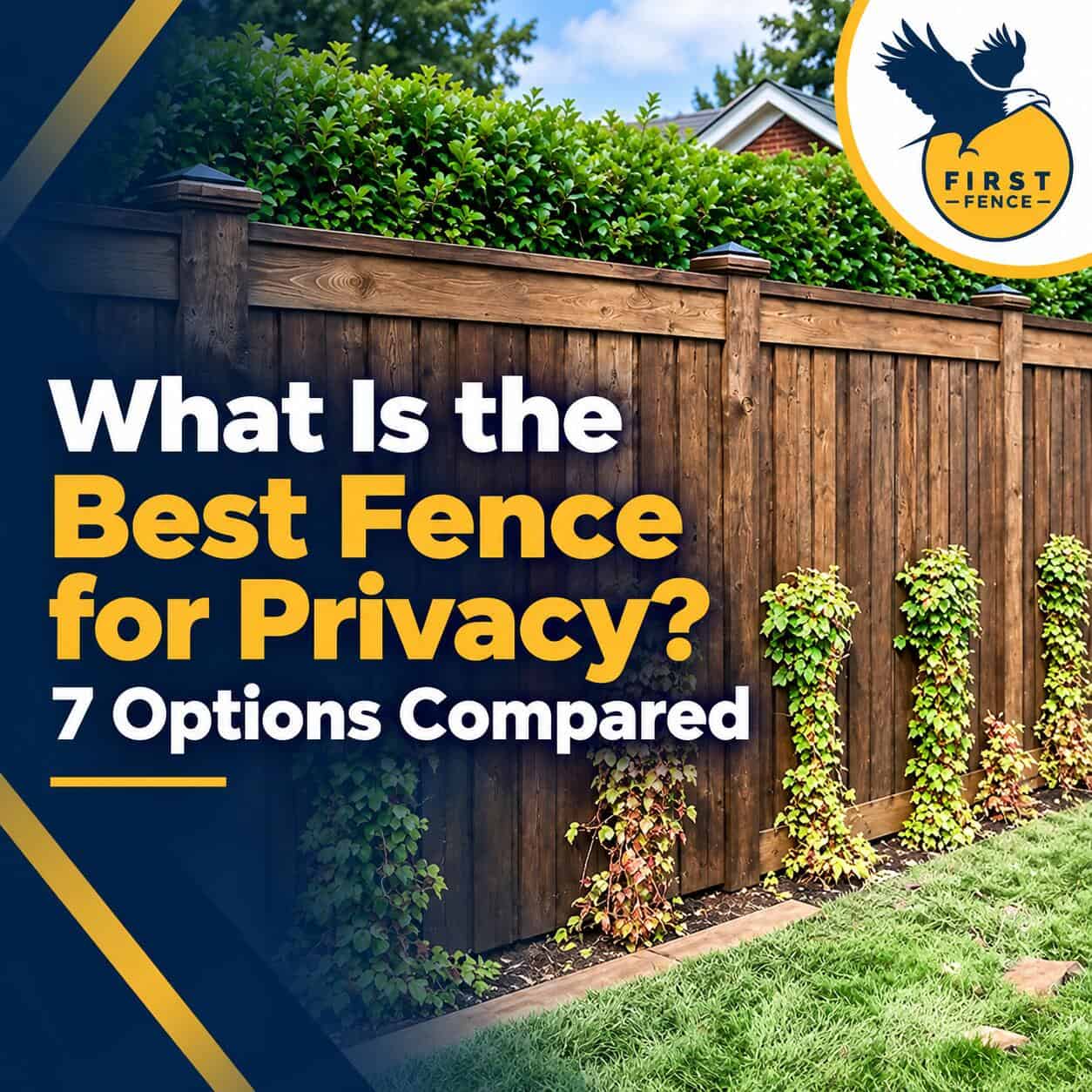
If privacy is your priority, choose a fence that blocks sightlines and minimizes gaps. For most backyards, a solid fence around 6 feet tall can provide effective privacy. Vinyl and composite fences with solid panels are popular options, while solid-board or layered cedar fences offer greater privacy for wood fencing. Board-on-board wood fencing is a semi-private option because visibility may still be possible from certain angles. Fence height, construction, placement on your property, and local regulations can all affect the level of privacy your fence provides.
So, what is the best fence for privacy? Below, we compare seven popular options, from classic wood to low-maintenance alternatives, and explain the strengths and limitations of each. By the end, you’ll have a better idea of which privacy fence fits your yard, budget, maintenance preferences, and local requirements.
Understanding Privacy Fence Materials vs. Styles
Not every option on this list represents the same type of choice. Wood, vinyl, composite, chain link, and aluminum are fence materials, while board-on-board and shadowbox are construction styles, typically used with wood. The construction style affects how much privacy the fence provides. In many cases, you’ll choose both: the material you want and the style that best fits your privacy needs.
Privacy Fence Comparison: Materials, Maintenance and Durability
| Fence Type | Privacy | Maintenance | Durability | Appearance | Best For |
|---|---|---|---|---|---|
| Wood privacy | High | Moderate | Good | Natural | Traditional backyard privacy |
| Vinyl privacy | High | Low | Good | Clean, modern | Low maintenance |
| Composite | High | Low | High | Wood-like | Premium low-maintenance option |
| Chain link + slats or screening | Moderate to high | Low | High | Functional | Containment plus partial privacy |
| Aluminum | Low without screening | Low | High | Decorative | Boundaries and appearance |
| Solid Board or Layered | Very high | Moderate | Good | Traditional | Maximum wood privacy |
7 Best Types of Privacy Fences for Your Backyard
The best privacy fence depends on more than just how solid it looks. Material, construction style, maintenance, durability, cost, and local requirements can all affect which option makes the most sense for your yard. Here are seven popular fence options to consider, along with what each does well and where it may fall short.
1. Wood Privacy Fence
A solid wood fence is the classic backyard privacy fence. First Fence builds its wood fences with Western Red Cedar, which is naturally resistant to rot and insects and has a warm grain that weathers to a silver-gray if left untreated.
- Privacy level: High when boards are tight; side-by-side boards can open small gaps as wood dries.
- Maintenance: Periodic staining or sealing if you want to keep the original color, plus routine inspection.
- Durability: Good, with attention to posts, ground contact, and drainage.
- Appearance: Natural and traditional; highly customizable.
- Best for: Homeowners who want a natural look and design flexibility.
- Drawbacks: Needs more upkeep than vinyl or composite.
2. Vinyl Privacy Fence
Vinyl (PVC) privacy fencing uses solid, interlocking panels, so there’s nothing to see through. It’s the go-to choice for homeowners who want a fence that is virtually maintenance free.
- Privacy level: High. Solid panels block visibility completely.
- Maintenance: Low. Occasional cleaning with a hose and mild soap, plus inspection.
- Durability: Good. Won’t rot, and it holds its color. Quality panels and proper post installation matter in our freeze-thaw winters.
- Appearance: Clean and uniform, in white, tan, gray and woodgrain looks.
- Best for: Low-maintenance backyard privacy.
- Drawbacks: Higher upfront cost than many wood options; a damaged panel is replaced rather than patched.
3. Composite Privacy Fence
Composite fencing blends wood fibers and plastic into boards that look like wood without needing stain.
- Privacy level: High. Composite is typically built as a solid, gap-free fence.
- Maintenance: Low, though care instructions vary by manufacturer.
- Durability: High. Resists rot, warping and insects.
- Appearance: Wood-like, with modern and horizontal options.
- Best for: Homeowners who want the look of wood with low upkeep.
- Drawbacks: Typically the highest upfront cost on this list.
4. Chain Link with Privacy Slats or Screening
Standard chain link fencing is designed to allow visibility through the mesh, so it offers little privacy by itself. However, privacy slats woven through the mesh or screening attached to the fence can significantly reduce visibility. Adding shrubs, vines, or other landscaping can provide even more coverage over time.
- Privacy level: Moderate to high, depending on slat or screen type.
- Maintenance: Low. Watch posts, hardware, and any corrosion.
- Durability: High. Slats and screening add wind load, so posts need to be set properly.
- Appearance: Functional rather than decorative.
- Best for: Yards where containment matters as much as privacy, such as dog runs or side yards.
- Drawbacks: Never fully opaque; slats can fade over time.
5. Aluminum Fencing
Aluminum fencing typically uses open pickets, so it defines your property and adds curb appeal without blocking the view. For more privacy, pair it with hedges, arborvitae, or other landscaping to create a softer, layered screen that becomes fuller over time.
- Privacy level: Low without landscaping.
- Maintenance: Low. Inspect for damage and finish wear.
- Durability: High. Won’t rust.
- Appearance: Decorative and elegant.
- Best for: Front yards, pool areas and homeowners who want to keep a view.
- Drawbacks: Not a privacy fence on its own.
6. Board-on-Board Fence
Board-on-board is a construction style where boards are installed in two overlapping layers. Even as wood shrinks, the overlap keeps gaps from forming.
- Privacy level: Very high. This is the most private wood construction.
- Maintenance: Moderate, the same as any wood fence.
- Durability: Good, and it holds up well to wind when properly posted.
- Appearance: Traditional and substantial, finished on both sides.
- Best for: Maximum privacy in a natural material.
- Drawbacks: Uses more material than single-layer wood, which raises cost.
7. Shadowbox Fence
Shadowbox (also called good neighbor) fencing alternates boards on opposite sides of the rails. It looks the same from both sides, which is why neighbors tend to like it.
- Privacy level: High straight on; small sightlines can appear at sharp angles.
- Maintenance: Moderate.
- Durability: Good. The spacing lets wind pass through more easily.
- Appearance: Attractive and finished on both sides.
- Best for: Shared property lines.
- Drawbacks: Slightly less private than board-on-board.
What Makes a Fence Good for Privacy?
Privacy depends on how a fence is built just as much as the material you choose. A cedar fence with gaps between the boards won’t provide the same level of screening as a solid board-on-board design, even though both are made from wood. The factors that have the biggest impact on privacy include:
- Height: The single biggest factor in blocking sightlines.
- Board spacing and overlap: Solid panels and overlapping boards eliminate gaps.
- Board orientation: Horizontal fences need tight spacing to stay private.
- Terrain: On sloped yards, stepped panels can leave triangular gaps at the bottom unless the fence is racked or filled in.
- Gates: A solid gate should match the fence, or it becomes the weak spot.
- Placement and neighboring views: A second-story window next door may need landscaping or a pergola, not just a taller fence.
How Tall Should a Privacy Fence Be for Maximum Privacy?
For most backyards, 6 feet is the practical standard for a privacy fence. It is tall enough to block the view of a standing adult and is the height most homeowners have in mind when they picture a traditional privacy fence.
- 4-foot fences define property lines and help contain pets but provide little visual privacy.
- 5-foot fences offer more screening, particularly from seated eye level, but may still leave sightlines open.
- 6-foot fences provide substantial privacy for most backyards and are the most common choice for residential privacy fencing.
- Taller fences may provide additional screening, but they are only an option where local regulations allow them.
Keep in mind that fence height limits vary by municipality, zoning district, yard location, and whether the property is on a corner. Some communities also have visibility requirements near driveways and intersections that limit fence height or require open construction in certain areas.
Before choosing a height, check your local fence regulations. If you’re unsure what’s allowed on your property, we can help you determine the appropriate options during your estimate.
What Is the Best Privacy Fence for Your Needs?
The right privacy fence depends on what matters most to you. Some homeowners want maximum screening, while others prioritize low maintenance, natural appearance, affordability, durability, or keeping dogs safely contained. Here’s a quick look at which fence options make the most sense for each priority.
- Maximum privacy: Board-on-board cedar, solid vinyl or solid composite.
- Low maintenance: Vinyl or composite.
- Natural appearance: Western Red Cedar in a solid or board-on-board style.
- Privacy on a budget: A side-by-side cedar fence, or chain link with slats where full privacy isn’t essential.
- Privacy and durability: Composite or vinyl, or a well-built cedar fence with properly set posts.
- Privacy for dogs: A solid 6-foot fence blocks sightlines that trigger barking, and a tight bottom and secure gate latch help with diggers and escape artists.
- Privacy from neighbors: Height, solid panels and smart placement, supplemented with landscaping for upstairs views.
Wood vs. Vinyl Privacy Fence: Which Is Better?
Is wood or vinyl better for privacy? Both can provide excellent privacy when built with solid, gap-free construction. The bigger difference comes down to what you want from the fence over time, particularly maintenance, appearance, durability, and cost.
| Factor | Cedar Wood | Vinyl |
|---|---|---|
| Initial cost | Generally lower | Generally higher |
| Maintenance | Staining or sealing to preserve color | Occasional washing |
| Appearance | Natural grain, weathers over time | Uniform, holds color |
| Customization | Highly customizable | Set panel styles and colors |
| Repairs | Individual boards can be replaced | Panels or sections are replaced |
| Weather | Moves with moisture | Doesn’t rot or absorb water |
| Privacy | High, very high in solid board | High with solid panels |
Choose cedar if you love the look of real wood and don’t mind upkeep. Choose vinyl if you’d rather never touch it.
How Much Does It Cost to Install a Privacy Fence?
The cost of a privacy fence depends on material, height, total footage, gates, site conditions and installation requirements. Specific factors include:
- Linear footage and fence height
- Material and construction style
- Number and size of gates
- Slopes or uneven terrain
- Removal of an existing fence
- Property access for installers
- Custom design details
The most reliable number is one based on your yard. First Fence provides free, itemized estimates so you can compare materials side by side.
Which Privacy Fence Requires the Least Maintenance?
No fence is maintenance-free, but some come close.
- Wood: Stain or seal periodically; inspect posts and boards.
- Vinyl: Wash occasionally; inspect after storms.
- Composite: Clean per the manufacturer’s guidance.
- Chain link: Check posts and hardware for damage or corrosion.
- Aluminum: Inspect for damage and finish wear.
Privacy Fence Installation Rules and Permits in Illinois
Before installing a privacy fence, it’s worth taking care of a few local details first. Illinois homeowners should check their municipality’s requirements and confirm that the fence location, height, and design meet local regulations. Key considerations include:
- Village fence code: Height limits, materials and setbacks vary from village to village.
- Corner lots and visibility triangles: These often carry tighter restrictions.
- Property lines: A plat of survey shows exactly where your fence can go.
- Permits: First Fence prepares the drawings, plat of survey, and material details. You submit and obtain the permit in your own name.
- HOA rules: If your community has an HOA, review its guidelines before choosing a style.
- Utility lines: Call JULIE before any digging.
- Neighbors: A quick heads-up goes a long way, especially on a shared line.
- Weather: Chicagoland wind and freeze-thaw cycles make post installation critical.
Frequently Asked Questions About Privacy Fences
What is the most private type of fence?
A solid fence with no gaps provides the most privacy. Board-on-board wood, solid vinyl panels, and solid composite fencing all block visibility completely when installed at 6 feet.
Is a 6-foot fence tall enough for privacy?
For most backyards, yes. A 6-foot fence blocks the view of a standing adult at ground level. It won’t block views from a neighbor’s second-story window, which is where landscaping or a pergola can help.
Can you see through a vinyl privacy fence?
No. Solid vinyl privacy panels interlock with no gaps, so they block visibility completely. Semi-private vinyl styles with spaced pickets or lattice tops are also available if you want some airflow.
What is better for privacy, board-on-board or side-by-side fencing?
Board-on-board is more private. Side-by-side boards can develop small gaps as wood dries and shrinks, while board-on-board’s overlapping layers keep the fence solid over time.
How do I make my fence more private?
You can add privacy slats to chain link, attach screening, plant evergreens along the fence line, or add a lattice topper where your village’s height limits allow. If your fence is aging, replacing it with a solid style is often the most effective option.
What type of fence is best for privacy and dogs?
A solid 6-foot vinyl, composite, or cedar fence works well. It blocks the sightlines that set off reactive dogs, discourages jumping, and closes off the yard. A tight bottom edge and a self-latching gate add security. Learn more about choosing the right materials and styles in our guide to the best fences for dogs.
Do privacy fences require permits?
In most Chicagoland villages, yes. First Fence prepares the drawings, plat of survey, and material details. You submit and obtain the permit in your own name.
How close can a privacy fence be to the property line?
It depends on your village. Some allow fences directly on the line, while others require a setback. Your plat of survey and local fence code will tell you where the fence can go, and we’ll review both during your estimate.
Find the Right Privacy Fence for Your Yard
The best privacy fence is the one that gives you the level of screening you want while fitting your budget, maintenance preferences, property, and local requirements. For maximum privacy, board-on-board cedar, solid vinyl, and composite are strong choices. If you prefer a natural look, Western Red Cedar offers more design flexibility, while vinyl and composite make sense if low maintenance is a priority.
The details of fence installation matter just as much as the material. Fence height, board spacing, construction style, gates, terrain, post installation, and placement can all affect how private the finished fence will be.
If you’re considering a privacy fence for your Chicagoland property, First Fence can help you compare your options and choose a design that fits your yard. We provide free, itemized estimates so you can compare materials, styles, and costs before making a decision.
Since 1989, First Fence has helped homeowners across the western and northwest suburbs, from our home base in Hillside to Elmhurst, Des Plaines and Clarendon Hills, choose and install privacy fencing built to last. Call 708.547.7555 or request a free estimate to compare your options.

Chris Buenz is the Sales Manager at First Fence, bringing more than two decades of experience with the company since joining full time in 2004. His extensive hands-on knowledge spans nearly every aspect of the fencing business, from helping customers select the right fencing solutions to overseeing projects ranging from straightforward installations to large, complex jobs. Chris understands the practical considerations that go into a successful fencing project and is committed to delivering quality results and a positive customer experience. He also plays an active role in improving company processes, supporting his team, and keeping First Fence aligned with evolving industry practices and innovations.