
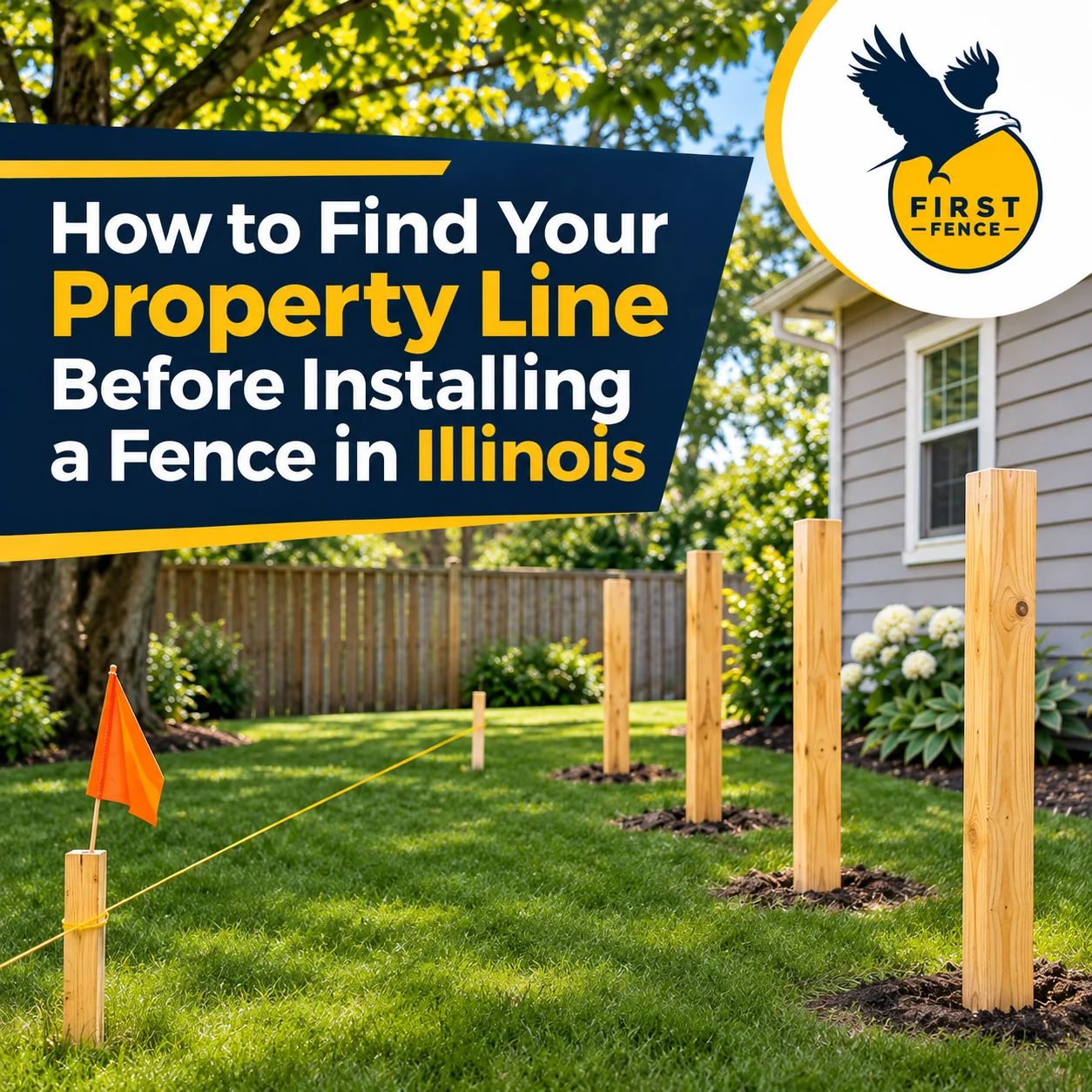
Before installing a fence, start by reviewing the plat of survey from your home purchase, comparing it with county property records, and checking for metal survey pins marking your lot corners. If the records don’t match or the pins are missing, hire a licensed land surveyor to establish the exact boundaries before installation begins.
That’s the basic process for finding your property line but getting it right matters more than you might think. A fence is one of the most difficult landscaping features to relocate once it’s installed. Even a few inches can put fence posts on a neighbor’s property or within a utility easement. The mistake may go unnoticed for years, only to surface when a neighbor sells their home or a new survey reveals the encroachment. Taking time to confirm your boundaries beforehand can save you from costly disputes, repairs, and unnecessary frustration.
5 Ways to Find Your Property Line Before Installing a Fence
There are several ways to determine where your property begins and ends, and some are easier than others. Before scheduling a surveyor, try these five steps to locate your property lines and get a clearer picture of your lot boundaries.
1. Check Your Plat of Survey
In Illinois, this document is usually called a plat of survey, and most homeowners already have one. It typically comes with the closing paperwork when you buy the house. If it isn’t in your folder, ask your title company, real estate attorney, or mortgage lender for a copy.
A plat of survey is a scaled drawing of your lot prepared by a licensed land surveyor. Three things on it matter for a fence:
- Each lot line is labeled with its length, so you can see that the rear line is, say, 50.00 feet.
- The lot corners are marked, with a note where the surveyor found or set an iron pipe or rod.
- Easements usually appear as dashed lines with a label such as “5′ public utility easement” along the back or side of the lot.
Look at the date, too. A survey from 1988 is still a real survey, but garages, additions, and the neighbor’s fence may have changed since then, and the corner pins it references may no longer be there.
2. Search County Property Records
No survey in your files? Your county is the next place to look. Your deed and the plat of subdivision that established your lot are recorded public documents. In Cook County, you can find them through the County Clerk’s recordings division; in DuPage County, check with the Recorder’s office. The county assessor’s website can also help you find your Property Index Number (PIN), which makes searching for other records much easier.
It’s important to understand what each document can tell you. Your deed provides the legal description of the property, often using a lot and block number that references a subdivision plat. The plat shows the lot’s original dimensions and layout, but neither document identifies the current location of your house, garage, or existing fence.
You can also contact your village’s building department. Depending on the municipality, it may have a copy of your plat of survey on file from a previous building permit.
3. Locate Property Line Markers and Survey Pins
Survey pins are iron pipes or rods driven into the ground to mark the corners of a property. Over time, they can become buried beneath several inches of soil, grass, and sod, making them difficult to spot.
If you’re wondering how to find property markers in your yard, start by using the measurements on your plat of survey to estimate where each corner should be. Then carefully probe the area or sweep it with a basic metal detector, which can make the search much easier. If you locate a pin, mark its position with a flag, but don’t pull it out or move it.
Keep two things in mind, though. First, a metal detector can’t distinguish a survey pin from old fence hardware, scrap metal, or a buried piece of rebar. Second, finding one pin only establishes a single point, not the entire property line. Before relying on a string line to mark your boundary, you need to locate the pins at both ends and confirm that the measured distance between them matches the dimensions on your survey.
4. Use Online Property Line Maps as a Reference
CookViewer lets you search by street address or Property Index Number (PIN) and view your parcel outlined over an aerial image. DuPage County offers a similar online parcel viewer.
However, treat these maps as a starting point, not an accurate boundary reference. They’re designed primarily for property tax assessment, not to establish legal property lines. The University of Illinois Extension makes this distinction clear, explaining that tax parcel maps are not a substitute for a boundary survey or plat of survey prepared by a licensed land surveyor. The boundary lines displayed online may be several feet off, so using an aerial map to position your new fence could put it on the wrong side of your actual property line.
5. Hire a Licensed Illinois Land Surveyor
A new boundary survey is the most reliable way to establish exactly where your property line falls. A licensed surveyor researches recorded property documents, measures the lot, locates or resets the corner pins, and can place stakes along the boundary so your fence installer has clear reference points to follow.
Hiring a surveyor is especially worthwhile when:
- You don’t have a plat of survey, or your copy is outdated or difficult to read.
- Corner pins are missing or their locations don’t match the measurements on your plat.
- A neighbor’s fence, hedge, or garage appears to sit close to or across your suspected property line.
- You own a corner lot or a property with an irregular shape.
- Your new fence will run directly along the property boundary.
This matters most for privacy fences, which usually run right along the rear and side lot lines. See our guide to the best fence for privacy to compare options.
Illinois land surveyors are licensed through the Illinois Department of Financial and Professional Regulation. Before hiring someone, verify their professional license to make sure they’re qualified to establish your property boundaries.
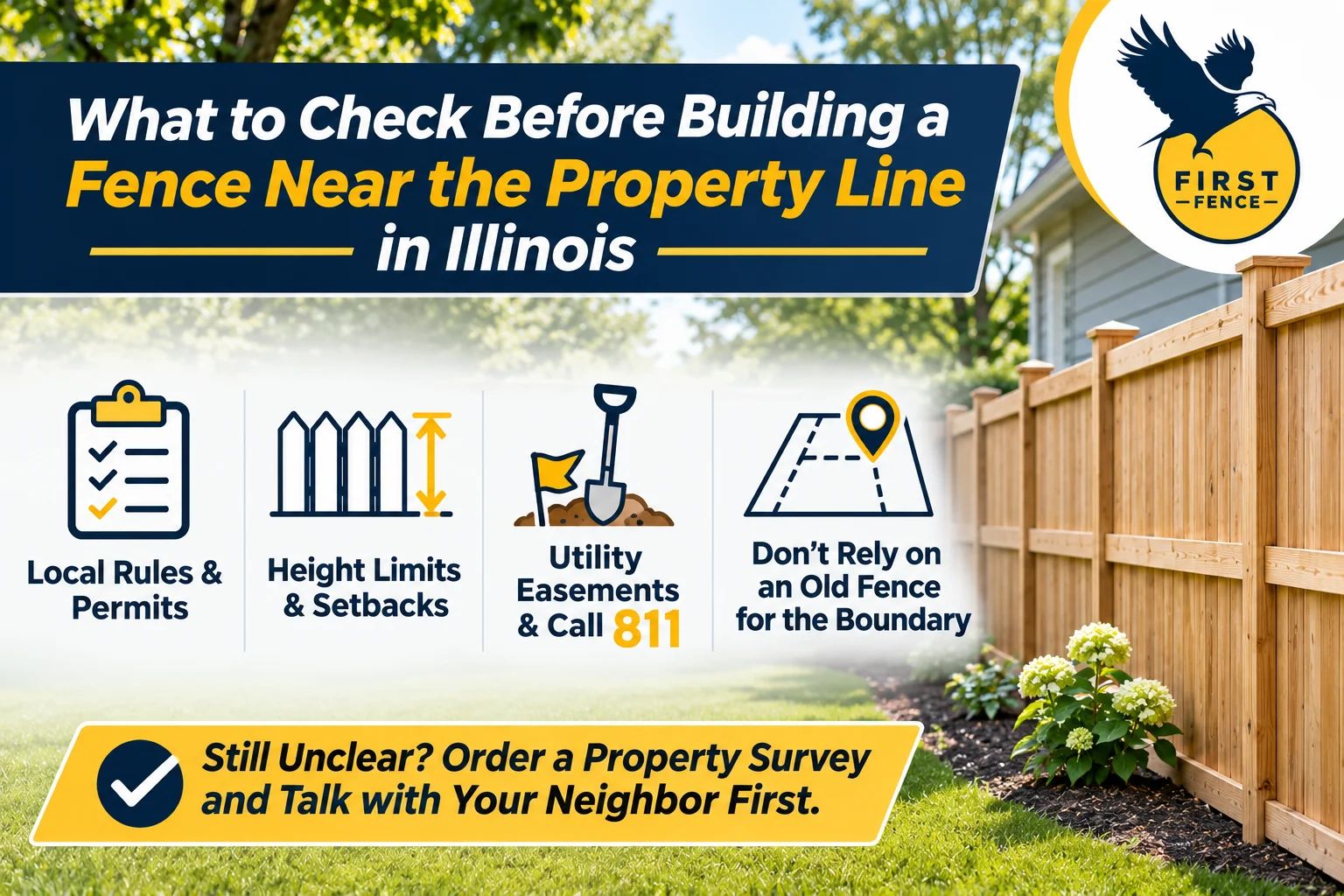
What to Check Before Building a Fence Near the Property Line in Illinois
Confirming your property line tells you where your fence can’t go, but it doesn’t necessarily show you where you’re allowed to build. Before installation begins, check for local zoning rules, setback requirements, utility easements, and permit requirements that could affect where your fence can go.
Fence Permits, Height Limits, and Setbacks
Every municipality sets its own limits on fence height, style, and placement, and they differ from one suburb to the next. Front yards and corner lots usually carry the most restrictions. Some places allow a fence on the lot line and others want it set inside. Ask your building department about permits and fence setback requirements before you settle on a layout.
Utility Easements and Calling JULIE (811)
A property easement gives a utility or the village the right to use a strip of your land. Some villages allow fences in easements and some don’t. Where it’s allowed, the utility can usually take down a section to reach its lines. Buried lines are a separate question. In Illinois, a request to JULIE (call 811) gets public utility lines marked at no charge before any digging.
Why an Old Fence Isn’t a Reliable Boundary
An old fence shows where somebody decided to build one. It may have been set a foot inside the line on purpose or placed by eye in 1975. The same goes for what your neighbor believes or what the previous owner told you. Everyone has heard “the line runs along those bushes.” Maybe it does but measure anyway.
If you’ve done all of this and the boundary is still unclear, stop and order the survey. A property boundary dispute costs far more than a surveyor does. And tell your neighbor about the project before the crew arrives. It’s a courtesy more than a legal step, and it heads off most arguments.
Do You Need a Survey to Install a Fence in Illinois?
It depends on where you live. Illinois has no single statewide rule, and requirements vary by municipality.
In the Chicago suburbs, most fence permit applications ask for a copy of your plat of survey with the proposed fence drawn on it. Elk Grove Village and Darien both list one among their submission requirements, and Darien asks for a recent one.
You can usually use your existing property survey to install a fence, as long as it’s legible, shows the lot as it stands today, and the pins it references can still be found. A new property survey for fence installation makes sense when any of those is in doubt, or when the fence will sit close to the line. Check with your village before construction starts.
Frequently Asked Questions About Finding Property Lines
Can I find my property line without a survey?
You can estimate it. A subdivision plat, county parcel maps, and corner pins will get you close. Only a licensed land surveyor can establish the exact legal boundary, so treat anything else as approximate, especially when the fence will sit near the line.
Are county property line maps accurate?
They’re accurate enough for tax purposes, but not for building a fence. County GIS parcel lines are drawn from recorded documents and laid over aerial photos, and they can be off by feet. Use them as a reference, never to lay out posts.
Can I use a metal detector to find property pins?
Yes. Iron survey pins usually sit a few inches below the surface at each lot corner, and an inexpensive detector will pick them up. Check what you find against the dimensions on your plat, because buried scrap metal sets off the same signal.
Can my neighbor’s fence show where my property line is?
No. A fence shows where someone chose to build, which may be inside the line, over it, or well off it. Fences are often set back on purpose or installed without a survey. Go by your plat of survey and the corner pins instead.
How close to your property line can you install a fence?
In most municipalities, you can install a fence directly on your property line (0 feet setback), but some require it to be set back 6 inches to 1 foot or more. Check your local fence regulations and property survey before installation to confirm the exact distance allowed.
How to find your property line for free by address
You can find your property line for free by entering your address into your county assessor’s website or GIS property map. These maps often show parcel boundaries, lot dimensions, and neighboring properties. You can also check your recorded property plat through the county recorder’s office. However, online maps are estimates and may not show exact boundary lines; a licensed surveyor can confirm the precise location.
Ready to Install a Fence in the Chicago Suburbs?
Once you know how to find your property line and have it confirmed on the ground, the rest of the project gets easier.
First Fence has been installing residential fences across the Chicago suburbs since 1989. Bring your plat of survey to your estimate and we’ll talk through layout, gates, materials, and installation for your yard. Call 708.547.7555 or request an estimate online.

Chris Buenz is the Sales Manager at First Fence, bringing more than two decades of experience with the company since joining full time in 2004. His extensive hands-on knowledge spans nearly every aspect of the fencing business, from helping customers select the right fencing solutions to overseeing projects ranging from straightforward installations to large, complex jobs. Chris understands the practical considerations that go into a successful fencing project and is committed to delivering quality results and a positive customer experience. He also plays an active role in improving company processes, supporting his team, and keeping First Fence aligned with evolving industry practices and innovations.