
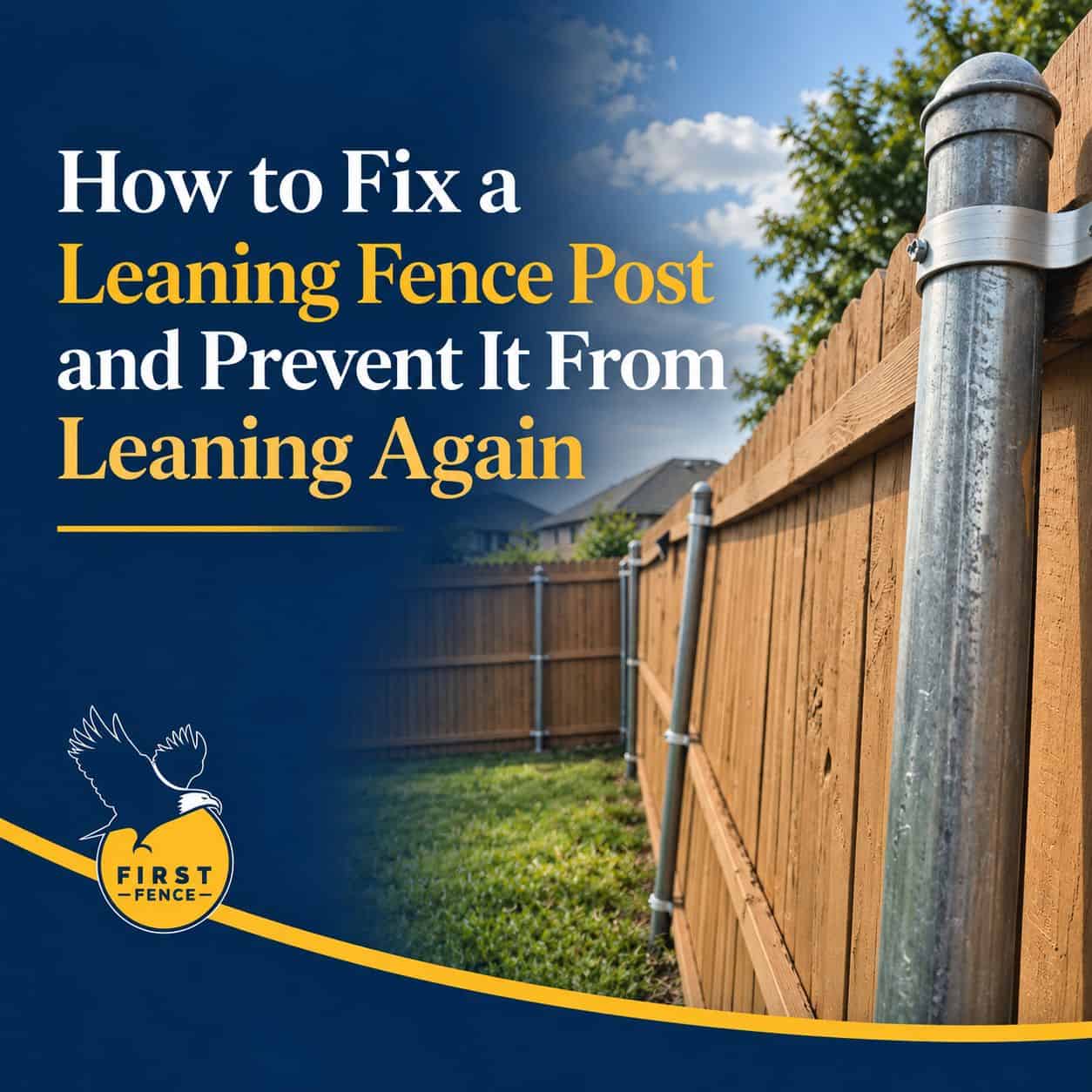
A leaning fence post can often be repaired if the post itself is still structurally sound. The repair usually involves digging around the footing, finding out why the post moved, bringing it back to plumb, and resetting or repairing the footing. If the post is rotted, cracked, broken, or continues to move after previous repairs, replacing the post is usually the better option.
A leaning fence post is often a sign that something has changed below the surface. Soil can shift, water can loosen the ground, frost can push the footing upward, or the constant pull of a gate can gradually move a post out of position.
The key is fixing why the post moved, not simply pushing it back into place. A quick straightening job may look fine temporarily, only for the same post to lean again after heavy rain, winter freeze-thaw cycles, or strong winds.
In this guide, we explain what causes fence posts to lean, how to repair a sound post, when replacement makes more sense, what repairs may cost, and how Chicagoland homeowners can prevent the problem from coming back.
Why Is My Fence Post Leaning?
Before you straighten a leaning fence post, it helps to understand what caused it to move in the first place. Different problems call for different repairs, and simply resetting the post without addressing the underlying cause may leave you with the same issue again. Here are some of the most common reasons a fence post starts to lean.
- The post wasn’t set deep enough: Depth is the single biggest predictor of whether a post stays put. A post set shallow has less soil holding it and far more leverage working against it.
- Frost heave: Northern Illinois soil freezes, expands, and pushes. When water in the ground around a footing freezes, it can lift the post upward or shove it sideways. Learn more about how winter conditions and frost heave affect fence posts.
- Waterlogged soil: Downspouts that discharge near the fence line, low spots that hold standing water, and heavy clay that drains slowly all soften the ground around a footing. Saturated soil simply doesn’t grip.
- Rot or structural damage: On a wood post, the failure point is almost always right at grade, where the wood meets the soil. The top of the post can look perfect while the base has gone soft. Western Red Cedar holds up well against moisture and insects thanks to its natural oils, but no wood is immune forever.
- Wind pressure: A six-foot privacy fence is a solid wall. Every gust loads that surface, and the posts absorb all of it. Long unbroken runs of privacy fence take the worst of it, which is why we pay extra attention to post spacing and depth on those installations.
- Gate stress: A gate post carries the gate’s full weight cantilevered off one side, plus the shock of the gate being opened and closed hundreds of times a season. If one post on your fence is leaning and it happens to be a gate post, you’ve probably found your answer.
- Age: Hardware loosens, footings crack, and wood weathers. A fence that’s been standing 20 years has earned a little movement.
Can a Leaning Fence Post Be Fixed?
Yes, many leaning fence posts can be repaired without replacing the entire post or fence section.
The deciding factor is the condition of the post and the footing beneath it.
| What you’re seeing | Repair or replace? |
|---|---|
| Post is solid, soil shifted | Usually repairable |
| Slight lean, fence otherwise tight | Usually repairable |
| Concrete footing has shifted or lifted | Repairable — footing needs resetting |
| Wood post is soft at the base | Usually replacement |
| Post is cracked or split | Usually replacement |
| Post keeps leaning after repair | Diagnose the underlying cause first |
| Several posts leaning together | Look at the whole fence, not one post |
The pattern matters more than many homeowners realize. One leaning post is usually an isolated repair. But if four or more posts are leaning in the same direction, you may be dealing with a drainage or installation problem, or a fence that is nearing the end of its service life.
What Do You Need to Fix a Leaning Fence Post?
The exact materials depend on what caused the post to move, but a typical repair may require:
- Shovel or post-hole digging tools
- Level
- Temporary braces
- Stakes
- Screwdriver or probe for checking wood rot
- Concrete mix if the footing needs to be replaced
- Fence fasteners
- Basic safety equipment
Before any digging begins, Illinois fence contractors should also request a utility locate.
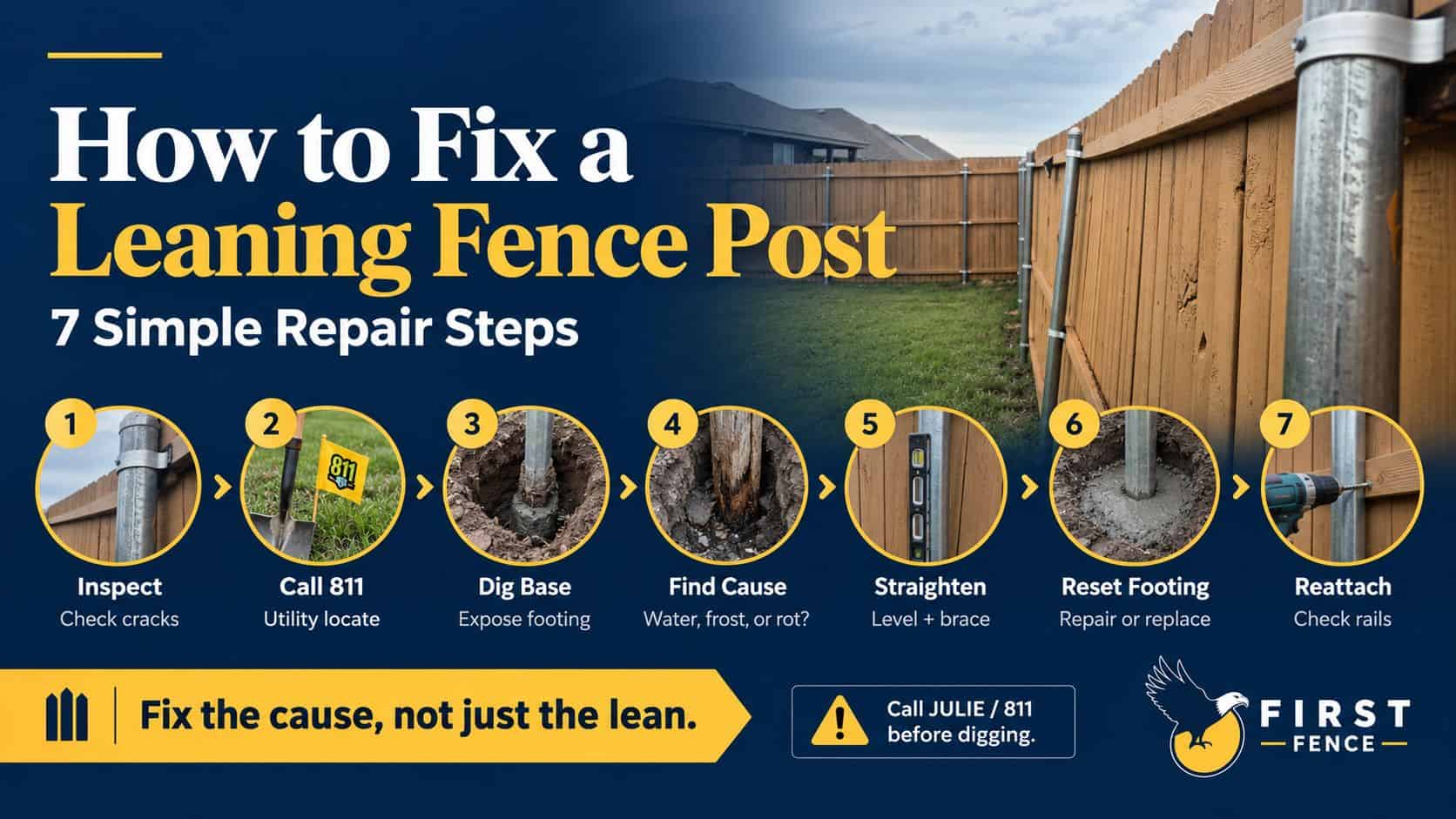
How to Fix a Leaning Fence Post
Once you know why the post is leaning and have confirmed that it is still structurally sound, you can move on to the repair. The process is straightforward, but each step matters: rushing the inspection, skipping the utility locate, or resetting the post without addressing the cause can lead to another failure. Here’s how to approach the repair from inspection through final reattachment.
- Step 1: Inspect the post before you touch it. Push on it. Does it move independently of the panels, or is the whole section moving with it? Press a screwdriver into the wood at grade and if it sinks in, you have rot. Check for cracks, check whether the footing is still intact, and check whether the fence itself is pulling the post over.
- Step 2: Contact JULIE before you dig. Illinois law requires a utility locate before excavation, and it’s free. Call 811 or submit online and give the member utilities time to mark the lines. Fence posts usually sit where irrigation, gas, and low-voltage lines run.
- Step 3: Remove the soil around the base. Dig out a ring around the post down to and past the footing. You’re not just making room to move the post, you’re looking for evidence. Is the concrete cracked? Is the hole full of water? Is the bottom of the post soft?
- Step 4: Figure out why it moved. Do this before you straighten anything. If the footing lifted evenly, you’re looking at frost. If the soil is soaked, you have a drainage issue. If the base is soft, the post is done and no amount of straightening will save it. This step is the difference between a repair that lasts and a repair that fails.
- Step 5: Straighten the post. Bring it back to plumb with a level, checking two adjacent faces rather than just one. Brace it with temporary supports staked into the ground so it holds position while you work. Take your time getting it right; you can’t adjust it later.
- Step 6: Reset and secure the footing. The right method depends on what’s already in the ground and what caused the failure. An intact footing that shifted may only need the surrounding soil excavated and backfilled properly. A cracked or undersized footing needs to come out and be redone at correct depth and diameter.
- Step 7: Reattach and check the fence. Once the post is solid, go over the rails, panels, and fasteners on both sides. A post that leaned has been pulling on its neighbors, and loose hardware there will start the next problem.
Can You Fix One Fence Post Without Replacing the Whole Fence?
Often, yes. If a single post has shifted while the surrounding posts, rails, and panels are still in good condition, there is usually no reason to replace more than necessary. One failed footing does not mean you need to tear out 80 feet of otherwise sound fence.
Repair becomes less practical when multiple posts are moving, the panels are deteriorating, hardware is failing throughout the fence, or the same post has already been reset once. At that point, repeated repairs can cost more without addressing the larger problem. A good fence contractor should tell you what they are seeing and explain whether repair or replacement makes more sense. If replacement is the better option, the work can often be phased by section to fit your timeline and budget.
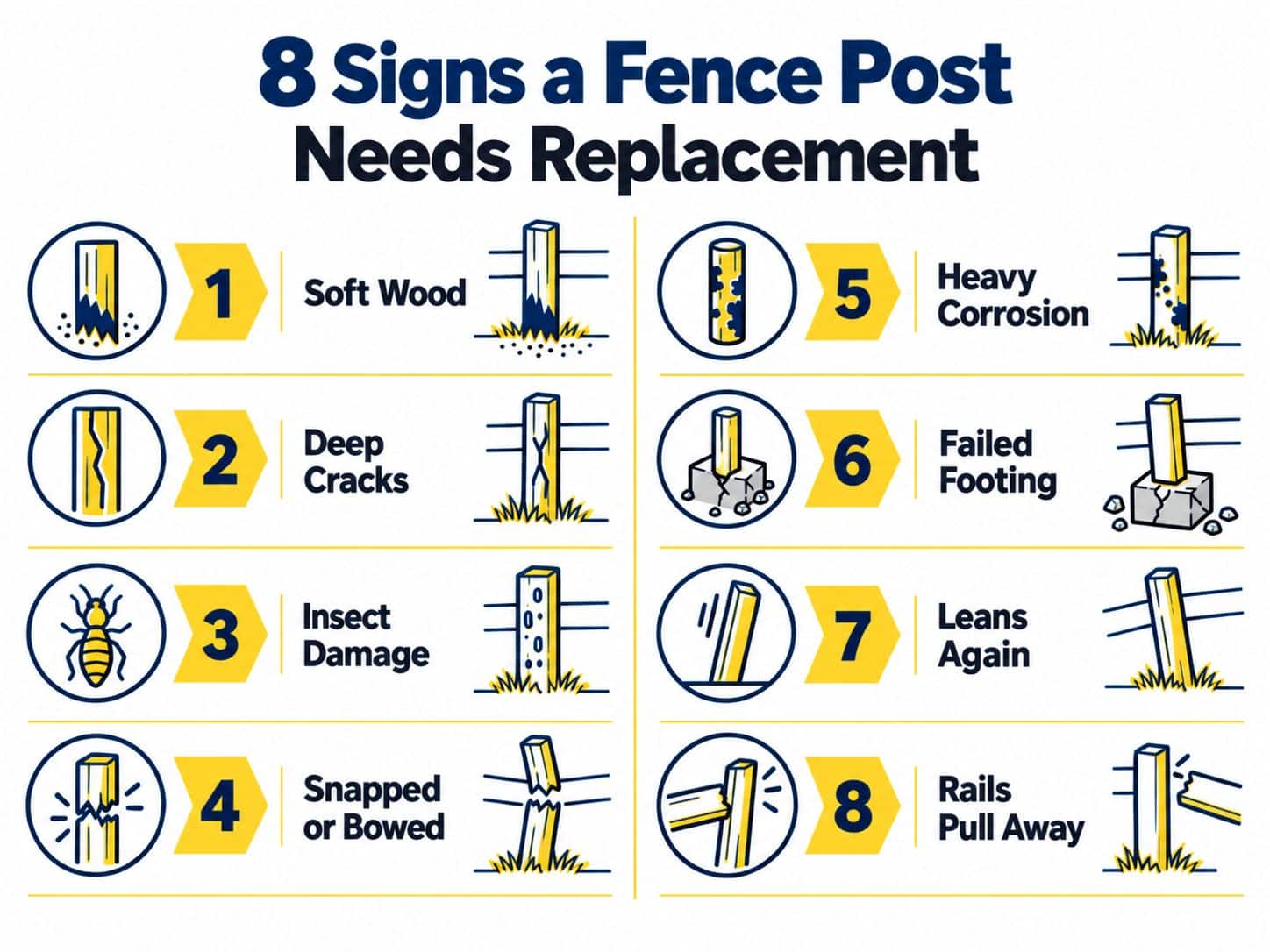
What Are the Signs a Fence Post Needs to Be Replaced?
- Soft or spongy wood at ground level
- Cracks or splits running through the post
- Significant insect damage
- A post that has snapped or is visibly bowed
- Heavy corrosion on a metal post
- A footing that has failed more than once
- The post leans again after being reset
- Rails and panels pulling away from the post on both sides
Why Does My Fence Keep Leaning After I Fix It?
If a fence post keeps leaning after you straighten it, the underlying problem probably was never addressed. In our experience, the most common causes are:
- The post was not installed deep enough in the first place.
- Frost is pushing the footing out of position each winter.
- Water is collecting around the base because of a downspout, poor grading, or a low spot.
- The post is rotted, and the previous repair corrected only its alignment.
- A large or heavy gate is putting more stress on the post than its footing can handle.
- The posts on either side are also unstable and pulling the repaired post out of position.
The goal is not simply to make the post look straight again. It is to correct whatever caused it to move. Address the underlying problem, and the repair has a much better chance of lasting. Skip that step, and you may find yourself making the same repair again next year.
Does Winter Cause Fence Posts to Lean in Chicagoland?
Yes, winter conditions can contribute to leaning fence posts throughout Chicago and the surrounding suburbs.
Frost movement is often one of the first things a fence contractor looks for when homeowners notice a leaning post after the ground thaws in March or April.
Water in the soil freezes and expands. That expansion places pressure on buried objects, including fence footings.
When the ground thaws, the soil settles again, but it does not always return to the same position. After repeated freeze-thaw cycles, a footing can gradually move upward or sideways.
Heavy clay soil can make this worse because clay retains moisture and drains more slowly than sandy soil.
How Deep Should Fence Posts Be in the Chicago Area?
Fence post depth depends on the fence design, local code requirements, soil conditions, and municipality.
In many Chicago-area communities, the local frost depth is commonly around 42 inches. Posts and footings need to be designed with local frost conditions in mind so seasonal ground movement does not continually push them upward.
Requirements can vary by municipality, so homeowners should check applicable local codes before installing or replacing fence posts.
Frost is not always the cause of a leaning post. Rot, drainage, wind, insufficient footing size, and gate stress can produce similar problems.
If your fence looked straight in the fall but began leaning shortly after the spring thaw, frost movement deserves closer inspection.
Why Are Leaning Fence Posts Common in Chicagoland?
Chicago and many surrounding suburbs have conditions that can be hard on fence footings.
Heavy clay soil can retain water around posts. Winter temperatures create repeated freezing and thawing. Spring rain can further saturate the ground, while summer storms place significant wind pressure on privacy fencing.
That combination makes proper post depth, footing size, drainage, and installation especially important.
First Fence works with homeowners throughout Chicagoland, including communities near Hillside, Elmhurst, Naperville, Bensenville, Oak Park, Burr Ridge, and surrounding western suburbs. Local soil conditions and seasonal weather patterns are important considerations when determining why a fence post moved and how it should be repaired.
How Much Does It Cost to Fix a Leaning Fence Post?
The cost to repair a leaning fence post depends on what caused the problem and how much work is required.
Factors that can affect the price include:
- Whether the existing post can be reused
- Whether the post needs replacement
- Condition of the concrete footing
- Fence material
- Fence height
- Accessibility
- Soil conditions
- Whether a gate is attached
- Number of affected posts
- Damage to rails or panels
- Whether additional drainage or structural corrections are needed
Resetting one structurally sound post is generally less involved than replacing a rotted post, rebuilding a gate footing, or repairing several leaning posts.
The best way to determine the cost is to inspect the post, footing, and surrounding fence before deciding whether repair or replacement makes more sense.
How to Prevent Fence Posts from Leaning
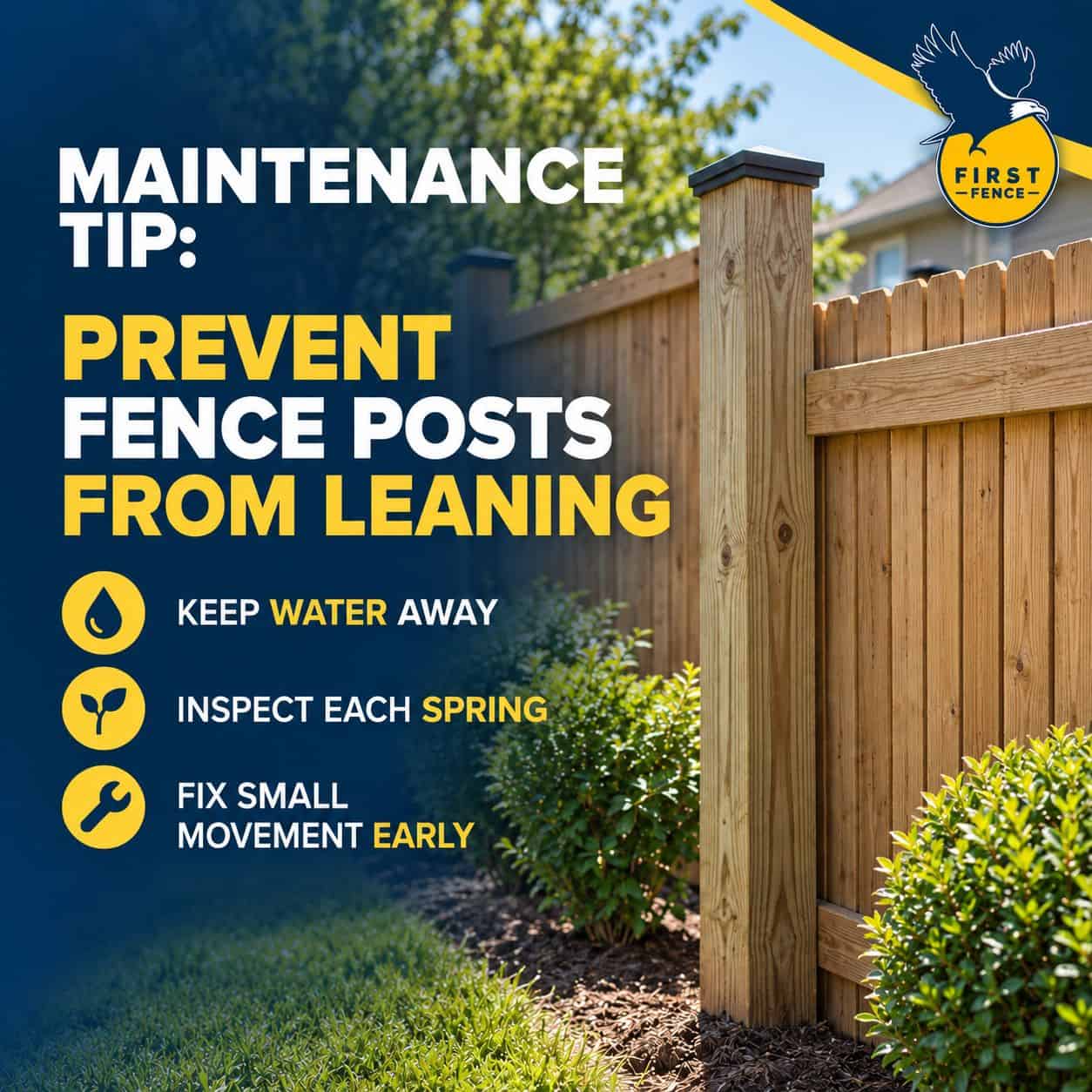
The best time to deal with a leaning fence post is before it starts leaning. Good installation and a little routine maintenance can prevent many of the problems that cause posts to shift, especially in areas with heavy clay soil and repeated freeze-thaw cycles. A few practices make the biggest difference:
- Set posts to the proper depth: Install them for local frost conditions rather than stopping at whatever depth the shortest post in the bundle allows.
- Size the footing for the load: Gate posts and corner posts carry more stress than line posts, so they need footings and materials designed for that additional load.
- Keep water away from the fence line: Redirect downspouts and correct low spots that allow water to collect around post footings.
- Space posts appropriately: Follow the requirements of the fence style, particularly with solid privacy panels that catch significant wind.
- Build gate posts for the gate: Large or heavy gates need stronger posts, deeper footings, and hardware rated for the load they will carry.
- Inspect the fence each spring: Push on posts, look for movement, and make sure gates still swing and latch properly.
- Address small problems early: A post that has just started moving is much easier to correct than one that has been leaning for years or has pulled neighboring sections out of alignment.
Should You Fix It Yourself, or Call a Fence Company?
A DIY repair can make sense when a single post is only slightly out of plumb, the post itself is structurally sound, you have clear access to the area, and you understand what caused it to move. If those conditions are met, straightening and resetting one post can be a manageable project.
It is worth calling a professional when several posts are leaning, a post is rotted or cracked, a gate is involved, the footing has failed, the fence sits on a slope or difficult terrain, or you cannot determine what caused the movement. A repair that addresses only the visible lean can leave the underlying problem untouched. There is no prize for diagnosing it wrong twice.
What Our Installers Look At
When a First Fence crew responds to a leaning post, we look beyond whether the post appears crooked. We inspect the post above grade, the size and condition of the footing, soil stability and drainage, the alignment of the entire fence run, rail and fastener connections, gate weight and hardware, and the condition of neighboring posts. We also look for patterns that point to frost movement or another underlying cause.
Then we explain what we found and what the repair will require. If resetting the post is a sound solution, we’ll tell you. We would rather fix one post properly today and have you call us for your next fence years from now than sell you a replacement you don’t need.
Leaning Fence Post? Let’s Take a Look
A leaning fence post does not always mean you need a new fence. If the post is still sound and the rest of the fence is in good condition, a proper repair can often restore it without disturbing everything around it. The important part is finding out why it moved in the first place, whether that means frost, drainage, poor installation, rot, wind, or the added weight of a gate.

If you have one post that has started to lean, it is worth dealing with it before the movement spreads to the rails, panels, or neighboring posts. And if several posts are moving, the right answer may be to look at the fence as a whole rather than treating each post as a separate repair.
Not sure whether your fence needs a simple reset or a larger repair? First Fence can inspect the post, footing, and surrounding fence and explain what we find. We’ll let you know when a repair makes sense and when replacement is the more practical long-term solution.
Call 708.547.7555 or request your free estimate online for our residential fence repair and installation services. We serve Chicagoland from our Hillside shop, from Naperville to Bensenville, and Oak Park to Burr Ridge.
Fence Post Repair FAQs
How do you straighten a leaning fence post?
Dig out the soil around the base, determine what caused the movement, bring the post back to plumb with a level, brace it in position, reset or repair the footing, and let it cure before reattaching the fence.
Why do fence posts lean?
Common causes are shallow installation, frost heave, waterlogged ground, rot at the base of a wood post, wind load on solid privacy fencing, and the extra stress a gate puts on its hinge post.
Can a leaning fence post be fixed without replacing it?
Usually. If the post is structurally sound and only the footing or soil moved, it can be straightened and reset. A rotted or cracked post should be replaced.
Can you fix one post without removing the whole fence?
Yes, in most cases. If the surrounding posts, rails, and panels are still sound, the repair is limited to the affected post.
Why does my fence keep leaning after I fix it?
Because the underlying cause wasn’t addressed. Insufficient post depth, poor drainage, frost movement, an undersized footing, hidden rot, or gate weight will all pull a post back out of plumb.
How deep should a fence post be set in the Chicago area?
Chicagoland villages generally require posts set at or below the local frost line, commonly around 42 inches. Requirements vary by municipality, so check your village’s code or ask your fence contractor.
Can frost cause a fence post to lean?
Yes. Freezing soil expands and can lift or shift a footing, and repeated freeze-thaw cycles move a post a little further each winter. It’s a frequent cause of leaning posts noticed in early spring in northern Illinois.
How do I know if a fence post is rotten?
Press a screwdriver into the wood at ground level. If it sinks in easily or the wood feels spongy, the post has rot and should be replaced rather than straightened.
Should I repair or replace a leaning fence post?
Repair when the post is solid and only the soil or footing moved. Replace when the post is rotted, cracked, broken, or has already been reset once and leaned again.
Can a leaning gate post be repaired?
Often, but gate posts need more than a straightening. Because they carry the gate’s weight and the repeated shock of opening and closing, a lasting repair usually means a deeper, larger footing and heavier post material.
Why is only one fence post leaning?
A single leaning post usually points to a localized cause such as a shallow hole, a bad pocket of soil, a downspout emptying nearby, rot in that one post, or a gate hanging off it.
Can you repair a fence post in winter?
Frozen ground makes excavation difficult and new concrete needs above-freezing conditions to cure properly. Temporary bracing can stabilize a post until conditions allow a permanent repair.